New Dashboard for Companion
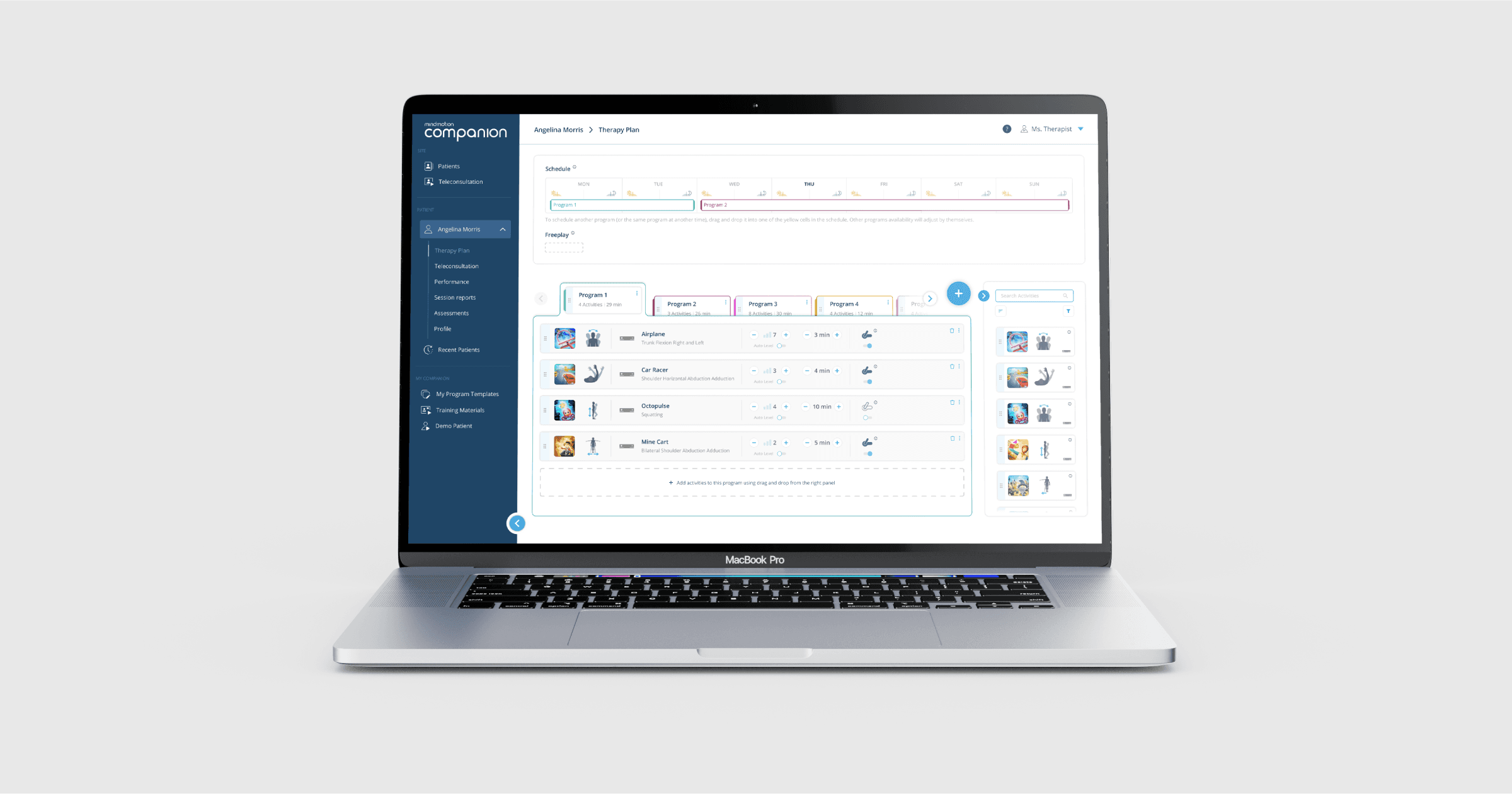
MindMotion Companion allows therapists to track patient progress toward their end goals effectively. With real-time data, the digital solution provides insights into both the quantity and quality of therapy patients receive. While a separate screen exists for detailed monitoring, a dashboard is essential for a quick overview of progress at a glance.
Client:
MindMaze
Role:
UX/UI Designer
Year:
2024
Duration:
1 Month

Who, What and Why
Who are the users?
Therapists who give rehabilitation therapy to patients who suffers from neurological diseases like Parkinson’s, Alzheimer's, Acute Spinal Cord Injury, neuromuscular disorders etc.
Who are the users?
Therapists who give rehabilitation therapy to patients who suffers from neurological diseases like Parkinson’s, Alzheimer's, Acute Spinal Cord Injury, neuromuscular disorders etc.
What are user goals?
To help patients reach their final goal by evaluating their weekly exercise objectives and progression of the patient's training and also determining training dosage based on the data analysis
What are user goals?
To help patients reach their final goal by evaluating their weekly exercise objectives and progression of the patient's training and also determining training dosage based on the data analysis
Why new welcome experience?
At present, a therapist must evaluate multiple data to determine the patient's training performance. Besides, there is a lack of clarity between the patient and therapist regarding the trajectory towards the patient's goal and objectives
Why new welcome experience?
At present, a therapist must evaluate multiple data to determine the patient's training performance. Besides, there is a lack of clarity between the patient and therapist regarding the trajectory towards the patient's goal and objectives
Challenges
Every therapist usually has a unique workflow, which means a one-size-fits-all dashboard may not be effective. The present project scope restrict us to design a dynamic dashboard.
Challenges
Every therapist usually has a unique workflow, which means a one-size-fits-all dashboard may not be effective. The present project scope restrict us to design a dynamic dashboard.
Problem Discovery
Layout is not making optimal use of the space
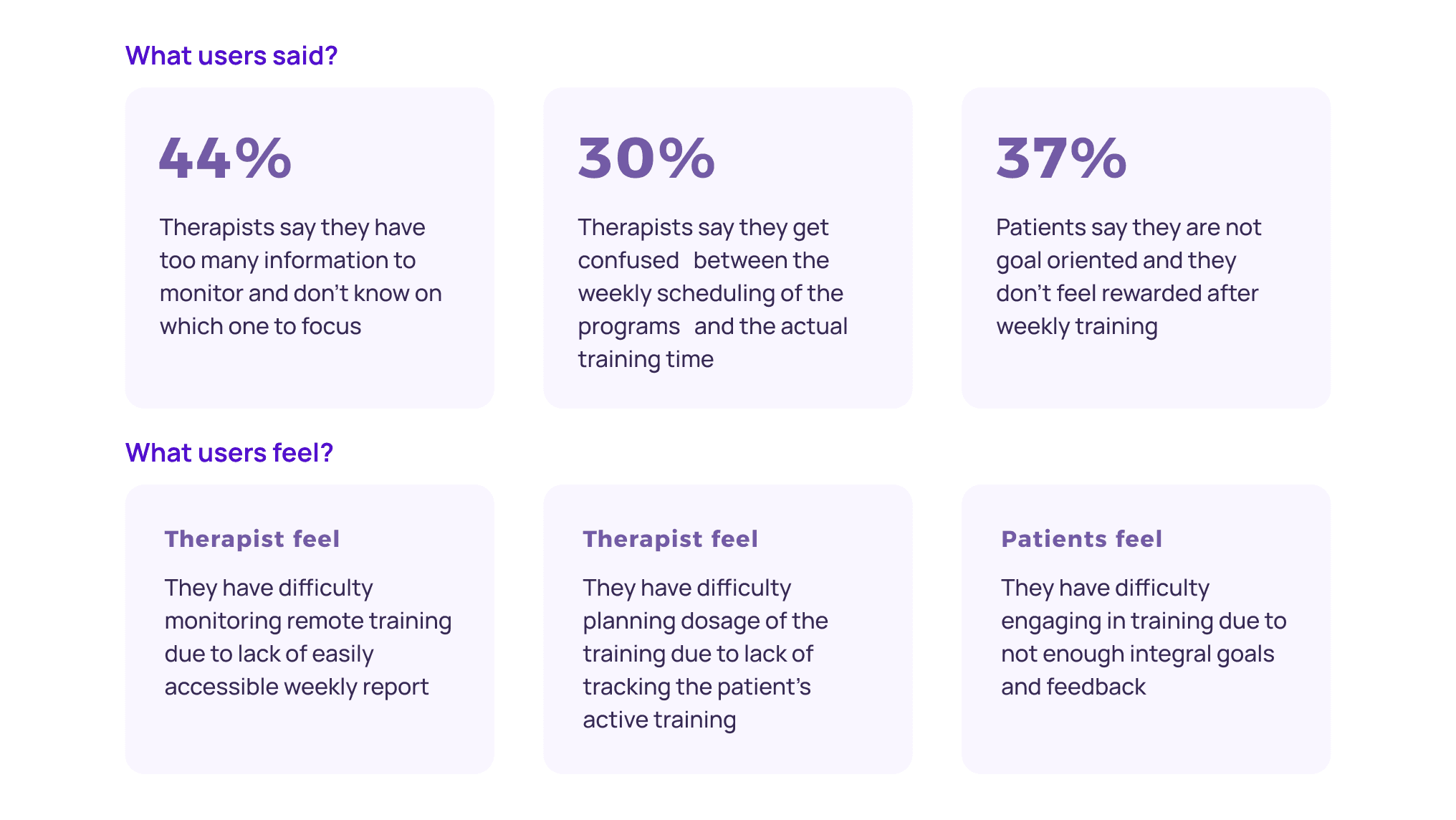
User Survey Insights
Therapists are unable to convey patients about their therapy progress
Therapists are unable to convey patients about their therapy progress
Patient unaware about the therapy process objectives and end goal
Patient unaware about the therapy process objectives and end goal
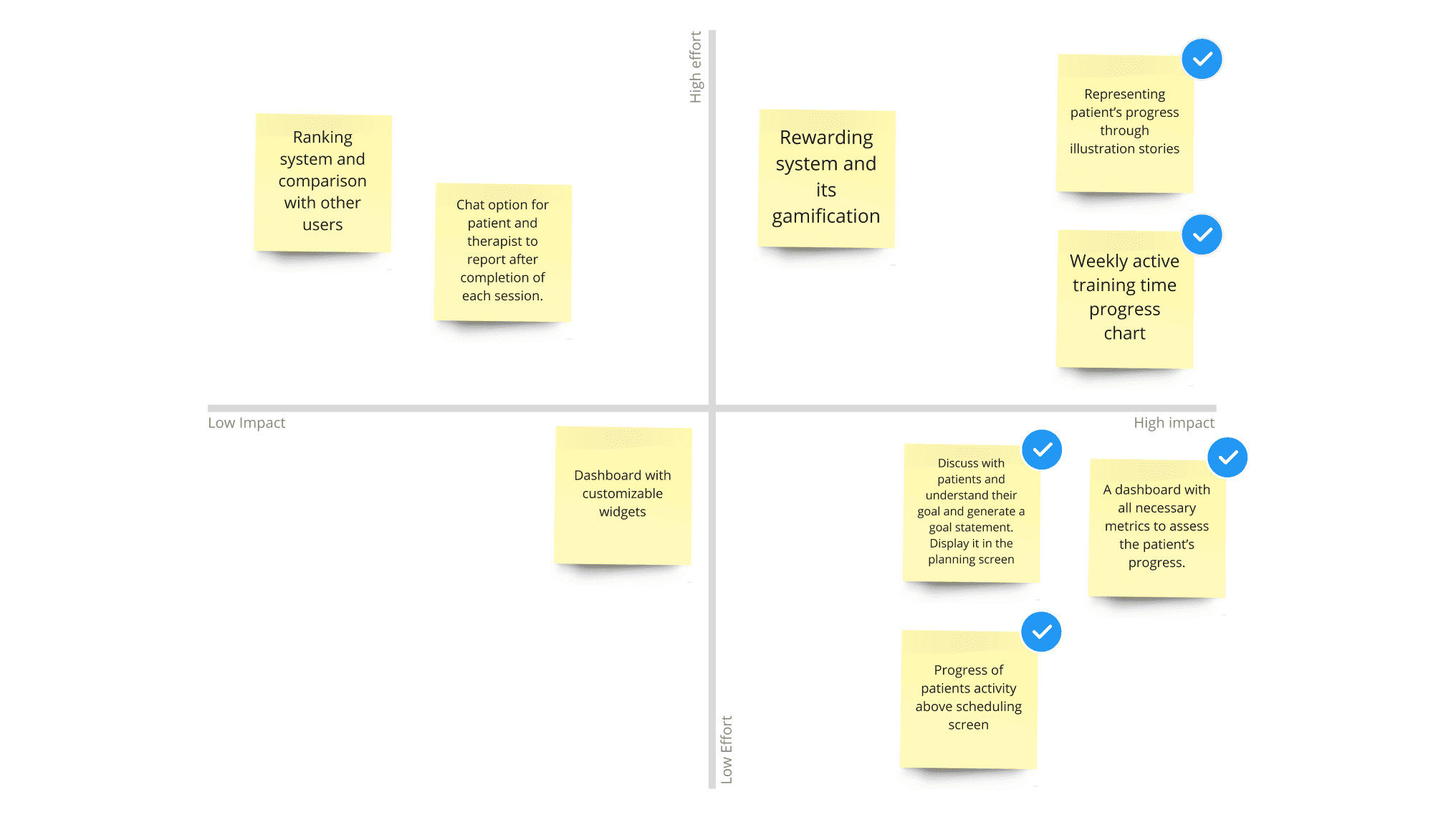
Brainstorming and Prioritization
Ideation workshops had been conducted to generate as many ideas as we could, then assessed to understand the feasibility and effort to prioritize
Ideation workshops had been conducted to generate as many ideas as we could, then assessed to understand the feasibility and effort to prioritize
Ideation and Exploration
Team that collaborates
Fortunate to have a team consisting of therapists, developers, user researcher, product managers to understand the needs of users and help ideate solutions
Fortunate to have a team consisting of therapists, developers, user researcher, product managers to understand the needs of users and help ideate solutions

Final Design Outcomes
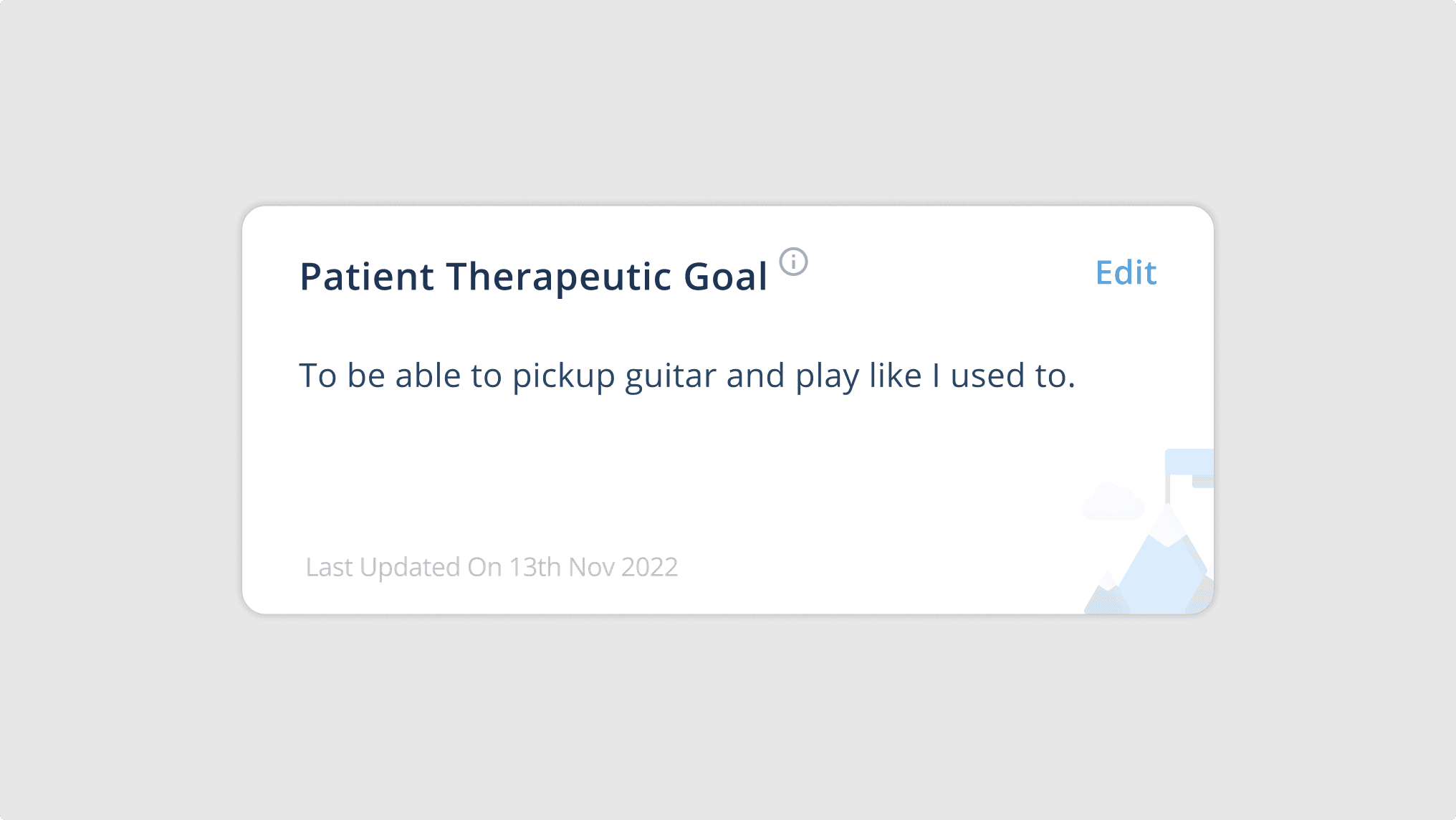
Therapeutic Goal
Therapeutic goal is the end goal which patient wish to achieve at the end of the program. Patient establishes this goal with therapists guidance
Therapeutic goal is the end goal which patient wish to achieve at the end of the program. Patient establishes this goal with therapists guidance
We decided to display the goal to therapists as well as patients so that they will focus and reminded more about the end result
We decided to display the goal to therapists as well as patients so that they will focus and reminded more about the end result
Weekly Active Training Time
The therapist sets the weekly training dosage after assessing patient's ability and previous training sessions
The therapist sets the weekly training dosage after assessing patient's ability and previous training sessions
Therapists closely monitor patient's progress and can adjust weekly training objectives as needed
Therapists closely monitor patient's progress and can adjust weekly training objectives as needed
Therapists will review weekly training time progress mainly in the dashboard
Therapists will review weekly training time progress mainly in the dashboard
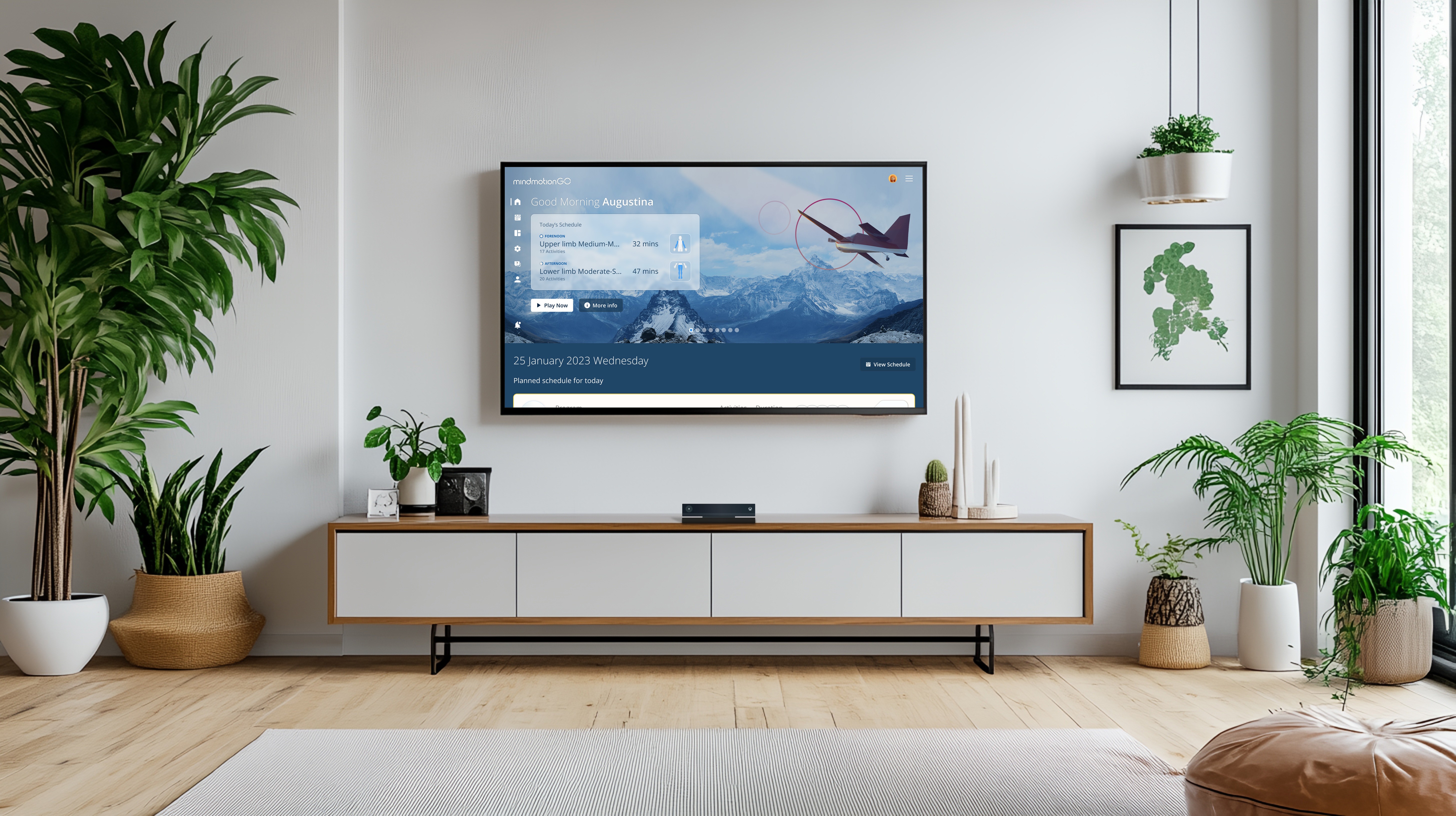
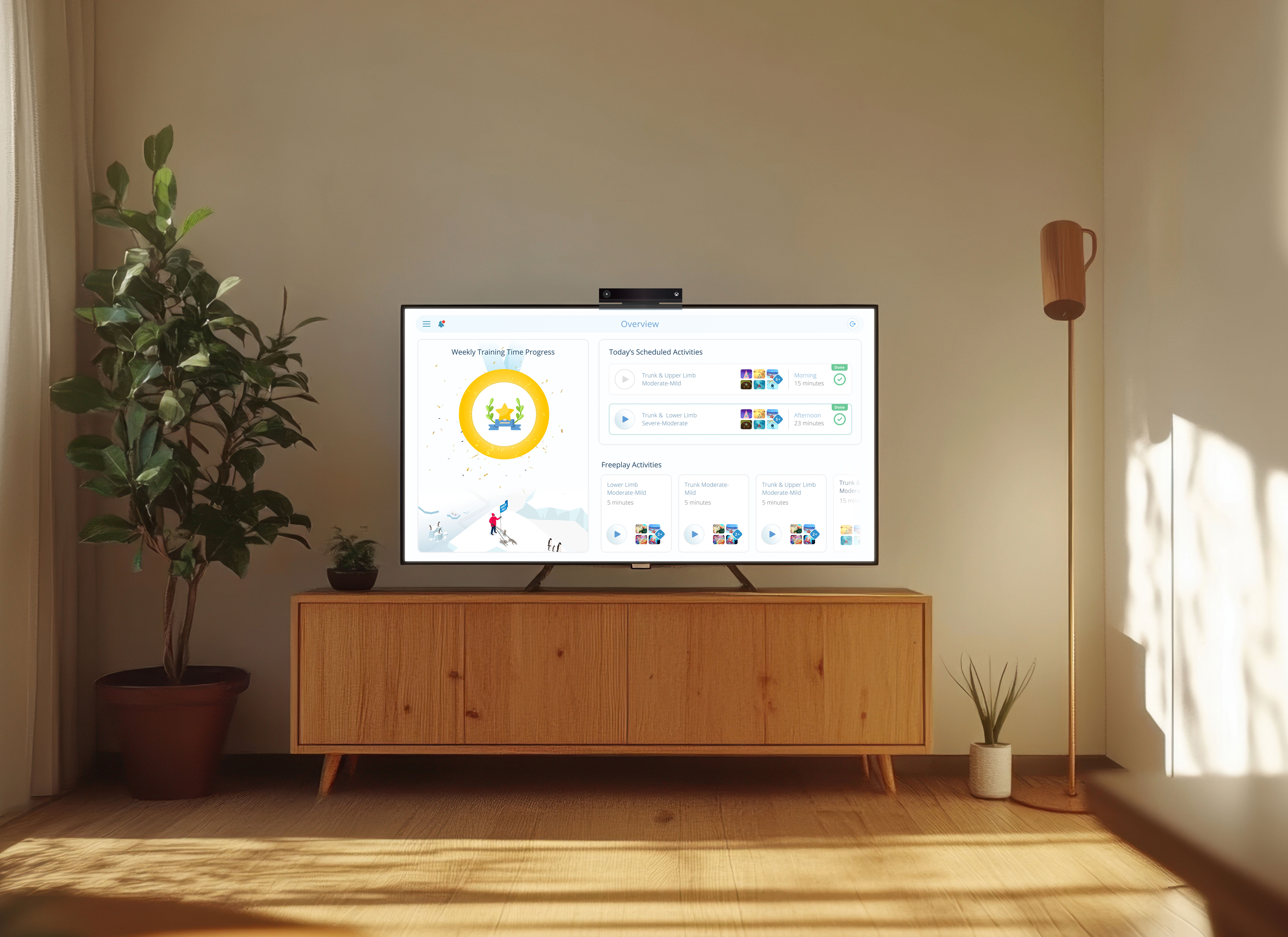
Patients can view their progress through their interface (MMGO, detailed in another case study)
Patients can view their progress through their interface (MMGO, detailed in another case study)
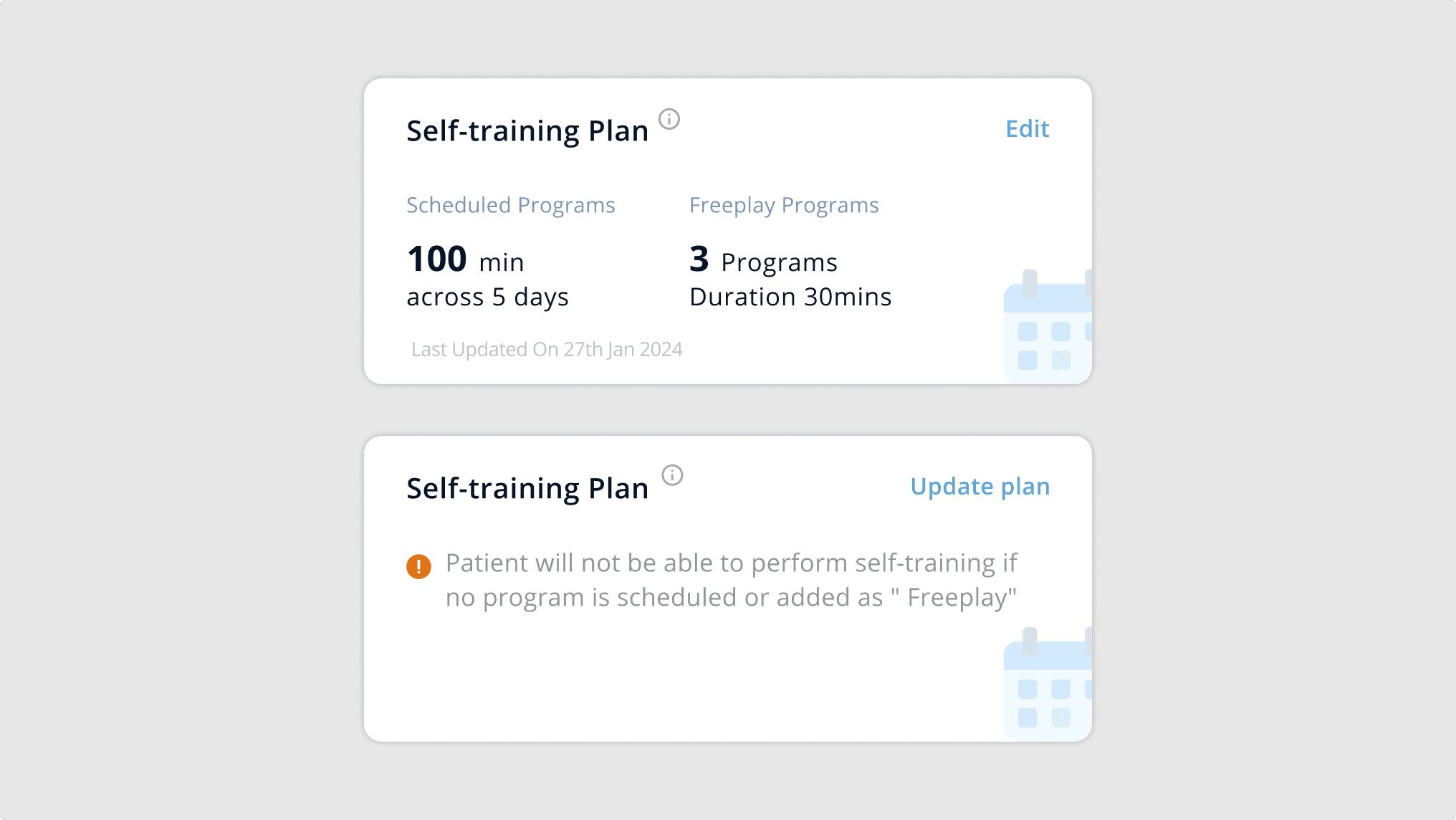
Planned Training
This card shows the minimum duration of training the patient can do in the coming week
This card shows the minimum duration of training the patient can do in the coming week
Planned training is split into two: Scheduled Program and
Free-play Programs
Planned training is split into two: Scheduled Program and
Free-play Programs
Scheduled Program consist of activities that is scheduled in the coming week. The duration is pre-planned by the therapist
Scheduled Program consist of activities that is scheduled in the coming week. The duration is pre-planned by the therapist
Freeplay program consist of activities that can be played anytime by the patient, duration is not set by the therapist
Freeplay program consist of activities that can be played anytime by the patient, duration is not set by the therapist
Patient Profile
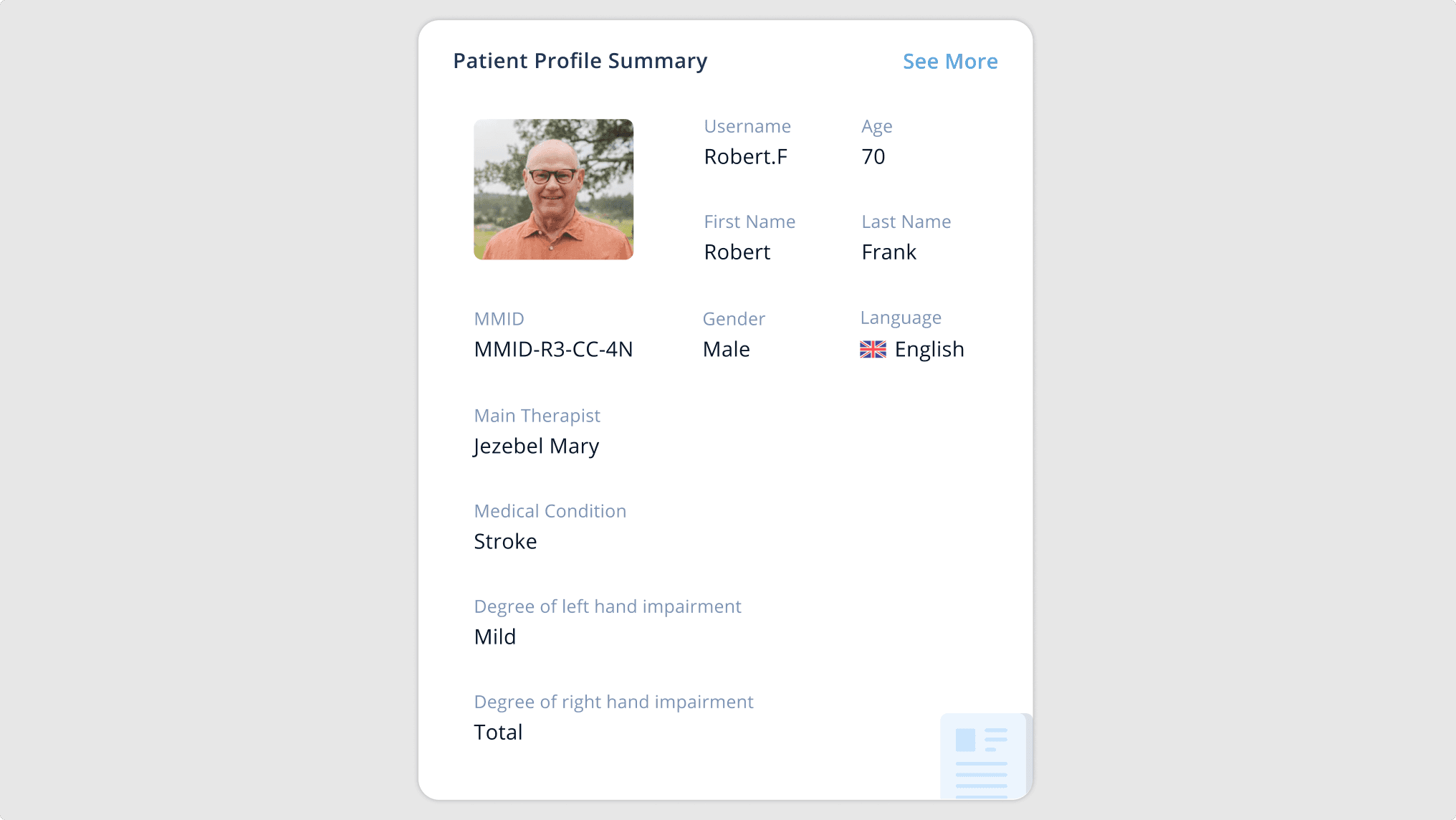
Widget shows the basic information about the patient they are reviewing
Widget shows the basic information about the patient they are reviewing
This will help therapist to identify patient and their conditions
This will help therapist to identify patient and their conditions
Presenting the final version of the dashboard
Widget shows the basic information about the patient they are reviewing
Widget shows the basic information about the patient they are reviewing
This will help therapist to identify patient and their conditions
This will help therapist to identify patient and their conditions
Session History
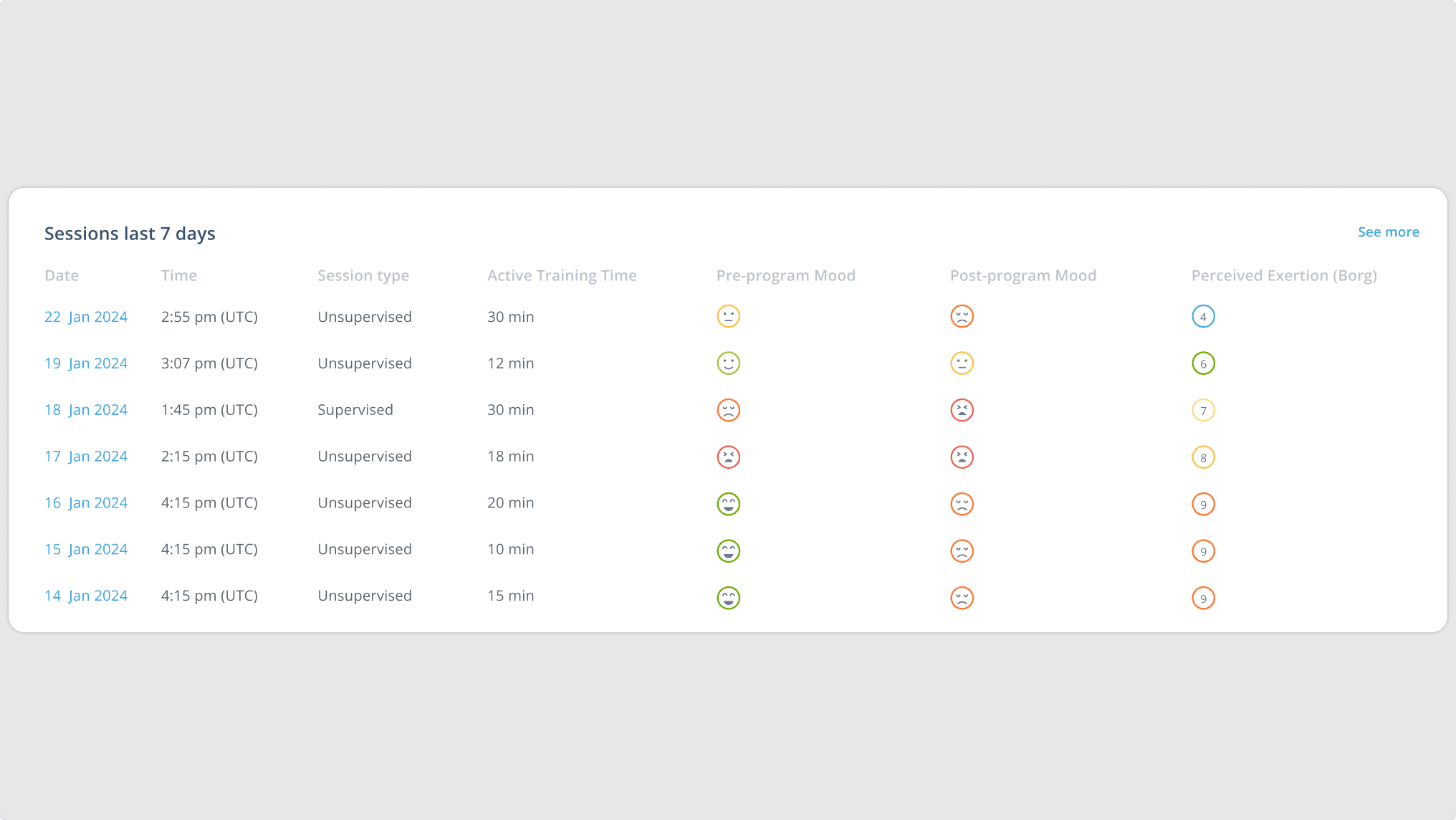
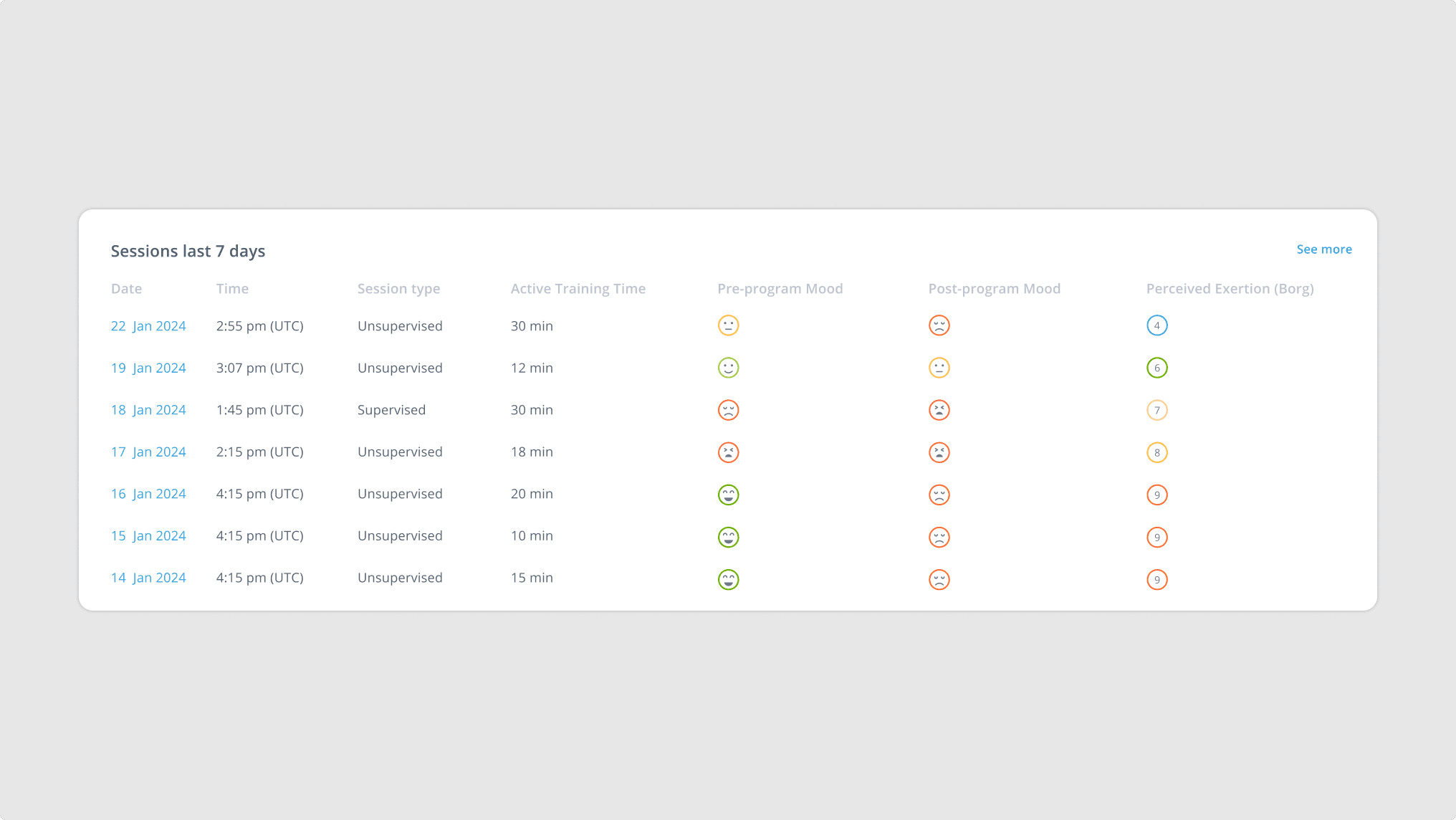
Highlights from the past week’s sessions are displayed here. Therapists can view session timing, type, duration, patient mood, and Borg exertion scale ratings
Highlights from the past week’s sessions are displayed here. Therapists can view session timing, type, duration, patient mood, and Borg exertion scale ratings
Patient mood is assessed before and after training for quick feedback
Patient mood is assessed before and after training for quick feedback
Perceived exertion is recorded post-session to gauge effort levels
Perceived exertion is recorded post-session to gauge effort levels
Weekly Active Training Time History
History of the training progress in the past weeks are visualized in a graph
History of the training progress in the past weeks are visualized in a graph
This will help therapist to make quick decisions to adjust the weekly training goal
This will help therapist to make quick decisions to adjust the weekly training goal
Impact of the new design
The dashboard is well-organized and allows for quick access to essential patient information. The Therapeutic Goal card is particularly valuable, as it reminds me of each patient’s personal goals and keeps treatment focused. I also appreciate the Weekly Training History and Current Week Active Training cards, which give a clear snapshot of training progress.

Marissa
Physiotherapist
The dashboard is well-organized and allows for quick access to essential patient information. The Therapeutic Goal card is particularly valuable, as it reminds me of each patient’s personal goals and keeps treatment focused. I also appreciate the Weekly Training History and Current Week Active Training cards, which give a clear snapshot of training progress.
Marissa
Physiotherapist
What users say about the new dashboard!
Retrospective
Ideation process can result in overwhelming amount of ideas, but as a designer and team player I learnt the importance of selecting the most viable features to be included in the first version of the solution
Ideation process can result in overwhelming amount of ideas, but as a designer and team player I learnt the importance of selecting the most viable features to be included in the first version of the solution
Its important to observe users and their behaviors while they are using the solution. They might be taking a longer route or misunderstood the use of some of the features. As a designer one should find the reasons behind such user behaviors
Its important to observe users and their behaviors while they are using the solution. They might be taking a longer route or misunderstood the use of some of the features. As a designer one should find the reasons behind such user behaviors
What I learnt from the project?
New Dashboard for Companion
MindMotion Companion allows therapists to track patient progress toward their end goals effectively. With real-time data, the digital solution provides insights into both the quantity and quality of therapy patients receive. While a separate screen exists for detailed monitoring, a dashboard is essential for a quick overview of progress at a glance.
Client:
MindMaze
Role:
UX/UI Designer
Year:
2024
Duration:
1 Month
Client:
MindMaze
Role:
UX/UI Designer
Year:
2024
Duration:
1 Month

Who, What and Why
Who are the users?
Therapists who give rehabilitation therapy to patients who suffers from neurological diseases like Parkinson’s, Alzheimer's, Acute Spinal Cord Injury, neuromuscular disorders etc.
Who are the users?
Therapists who give rehabilitation therapy to patients who suffers from neurological diseases like Parkinson’s, Alzheimer's, Acute Spinal Cord Injury, neuromuscular disorders etc.
What are user goals?
To help patients reach their final goal by evaluating their weekly exercise objectives and progression of the patient's training and also determining training dosage based on the data analysis
What are user goals?
To help patients reach their final goal by evaluating their weekly exercise objectives and progression of the patient's training and also determining training dosage based on the data analysis
Who are the users?
Therapists who give rehabilitation therapy to patients who suffers from neurological diseases like Parkinson’s, Alzheimer's, Acute Spinal Cord Injury, neuromuscular disorders etc.
What are user goals?
To help patients reach their final goal by evaluating their weekly exercise objectives and progression of the patient's training and also determining training dosage based on the data analysis
Why new welcome experience?
At present, a therapist must evaluate multiple data to determine the patient's training performance. Besides, there is a lack of clarity between the patient and therapist regarding the trajectory towards the patient's goal and objectives
Why new welcome experience?
At present, a therapist must evaluate multiple data to determine the patient's training performance. Besides, there is a lack of clarity between the patient and therapist regarding the trajectory towards the patient's goal and objectives
Challenges
Every therapist usually has a unique workflow, which means a one-size-fits-all dashboard may not be effective. The present project scope restrict us to design a dynamic dashboard.
Challenges
Every therapist usually has a unique workflow, which means a one-size-fits-all dashboard may not be effective. The present project scope restrict us to design a dynamic dashboard.
Why new welcome experience?
At present, a therapist must evaluate multiple data to determine the patient's training performance. Besides, there is a lack of clarity between the patient and therapist regarding the trajectory towards the patient's goal and objectives
Challenges
Every therapist usually has a unique workflow, which means a one-size-fits-all dashboard may not be effective. The present project scope restrict us to design a dynamic dashboard.
Problem Discovery
User Survey Insights
Therapists are unable to convey patients about their therapy progress
Therapists are unable to convey patients about their therapy progress
Therapists are unable to convey patients about their therapy progress
Patient unaware about the therapy process objectives and end goal
Patient unaware about the therapy process objectives and end goal
Patient unaware about the therapy process objectives and end goal
Ideation and Exploration
Brainstorming and Prioritization
Ideation workshops had been conducted to generate as many ideas as we could, then assessed to understand the feasibility and effort to prioritize
Ideation workshops had been conducted to generate as many ideas as we could, then assessed to understand the feasibility and effort to prioritize
Ideation workshops had been conducted to generate as many ideas as we could, then assessed to understand the feasibility and effort to prioritize
Team that collaborates
Fortunate to have a team consisting of therapists, developers, user researcher, product managers to understand the needs of users and help ideate solutions
Fortunate to have a team consisting of therapists, developers, user researcher, product managers to understand the needs of users and help ideate solutions
Fortunate to have a team consisting of therapists, developers, user researcher, product managers to understand the needs of users and help ideate solutions
Final Design Outcomes
Therapeutic Goal
Therapeutic goal is the end goal which patient wish to achieve at the end of the program. Patient establishes this goal with therapists guidance
Therapeutic goal is the end goal which patient wish to achieve at the end of the program. Patient establishes this goal with therapists guidance
Therapeutic goal is the end goal which patient wish to achieve at the end of the program. Patient establishes this goal with therapists guidance
We decided to display the goal to therapists as well as patients so that they will focus and reminded more about the end result
We decided to display the goal to therapists as well as patients so that they will focus and reminded more about the end result
We decided to display the goal to therapists as well as patients so that they will focus and reminded more about the end result
Weekly Active Training Time
The therapist sets the weekly training dosage after assessing patient's ability and previous training sessions
The therapist sets the weekly training dosage after assessing patient's ability and previous training sessions
The therapist sets the weekly training dosage after assessing patient's ability and previous training sessions
Therapists closely monitor patient's progress and can adjust weekly training objectives as needed
Therapists closely monitor patient's progress and can adjust weekly training objectives as needed
Therapists closely monitor patient's progress and can adjust weekly training objectives as needed
Therapists will review weekly training time progress mainly in the dashboard
Therapists will review weekly training time progress mainly in the dashboard
Therapists will review weekly training time progress mainly in the dashboard
Patients can view their progress through their interface (MMGO, detailed in another case study)
Patients can view their progress through their interface (MMGO, detailed in another case study)
Patients can view their progress through their interface (MMGO, detailed in another case study)
Planned Training
This card shows the minimum duration of training the patient can do in the coming week
This card shows the minimum duration of training the patient can do in the coming week
This card shows the minimum duration of training the patient can do in the coming week
Planned training is split into two: Scheduled Program and
Free-play Programs
Planned training is split into two: Scheduled Program and
Free-play Programs
Planned training is split into two: Scheduled Program and
Free-play Programs
Scheduled Program consist of activities that is scheduled in the coming week. The duration is pre-planned by the therapist
Scheduled Program consist of activities that is scheduled in the coming week. The duration is pre-planned by the therapist
Scheduled Program consist of activities that is scheduled in the coming week. The duration is pre-planned by the therapist
Freeplay program consist of activities that can be played anytime by the patient, duration is not set by the therapist
Freeplay program consist of activities that can be played anytime by the patient, duration is not set by the therapist
Freeplay program consist of activities that can be played anytime by the patient, duration is not set by the therapist
Weekly Active Training Time History
History of the training progress in the past weeks are visualized in a graph
History of the training progress in the past weeks are visualized in a graph
History of the training progress in the past weeks are visualized in a graph
This will help therapist to make quick decisions to adjust the weekly training goal
This will help therapist to make quick decisions to adjust the weekly training goal
This will help therapist to make quick decisions to adjust the weekly training goal
Session History
Highlights from the past week’s sessions are displayed here. Therapists can view session timing, type, duration, patient mood, and Borg exertion scale ratings
Highlights from the past week’s sessions are displayed here. Therapists can view session timing, type, duration, patient mood, and Borg exertion scale ratings
Highlights from the past week’s sessions are displayed here. Therapists can view session timing, type, duration, patient mood, and Borg exertion scale ratings
Patient mood is assessed before and after training for quick feedback
Patient mood is assessed before and after training for quick feedback
Patient mood is assessed before and after training for quick feedback
Perceived exertion is recorded post-session to gauge effort levels
Perceived exertion is recorded post-session to gauge effort levels
Perceived exertion is recorded post-session to gauge effort levels
Patient Profile
Widget shows the basic information about the patient they are reviewing
Widget shows the basic information about the patient they are reviewing
Widget shows the basic information about the patient they are reviewing
This will help therapist to identify patient and their conditions
This will help therapist to identify patient and their conditions
This will help therapist to identify patient and their conditions
Presenting the final version of the dashboard
Widget shows the basic information about the patient they are reviewing
Widget shows the basic information about the patient they are reviewing
Widget shows the basic information about the patient they are reviewing
This will help therapist to identify patient and their conditions
This will help therapist to identify patient and their conditions
This will help therapist to identify patient and their conditions
Impact of the new design
What users say about the new dashboard!
The dashboard is well-organized and allows for quick access to essential patient information. The Therapeutic Goal card is particularly valuable, as it reminds me of each patient’s personal goals and keeps treatment focused. I also appreciate the Weekly Training History and Current Week Active Training cards, which give a clear snapshot of training progress.
Marissa
Physiotherapist
The dashboard is well-organized and allows for quick access to essential patient information. The Therapeutic Goal card is particularly valuable, as it reminds me of each patient’s personal goals and keeps treatment focused. I also appreciate the Weekly Training History and Current Week Active Training cards, which give a clear snapshot of training progress.
Marissa
Physiotherapist
The dashboard is well-organized and allows for quick access to essential patient information. The Therapeutic Goal card is particularly valuable, as it reminds me of each patient’s personal goals and keeps treatment focused. I also appreciate the Weekly Training History and Current Week Active Training cards, which give a clear snapshot of training progress.
Marissa
Physiotherapist
Retrospective
What I learnt from the project?
Ideation process can result in overwhelming amount of ideas, but as a designer and team player I learnt the importance of selecting the most viable features to be included in the first version of the solution
Ideation process can result in overwhelming amount of ideas, but as a designer and team player I learnt the importance of selecting the most viable features to be included in the first version of the solution
Ideation process can result in overwhelming amount of ideas, but as a designer and team player I learnt the importance of selecting the most viable features to be included in the first version of the solution
Its important to observe users and their behaviors while they are using the solution. They might be taking a longer route or misunderstood the use of some of the features. As a designer one should find the reasons behind such user behaviors
Its important to observe users and their behaviors while they are using the solution. They might be taking a longer route or misunderstood the use of some of the features. As a designer one should find the reasons behind such user behaviors
Its important to observe users and their behaviors while they are using the solution. They might be taking a longer route or misunderstood the use of some of the features. As a designer one should find the reasons behind such user behaviors